
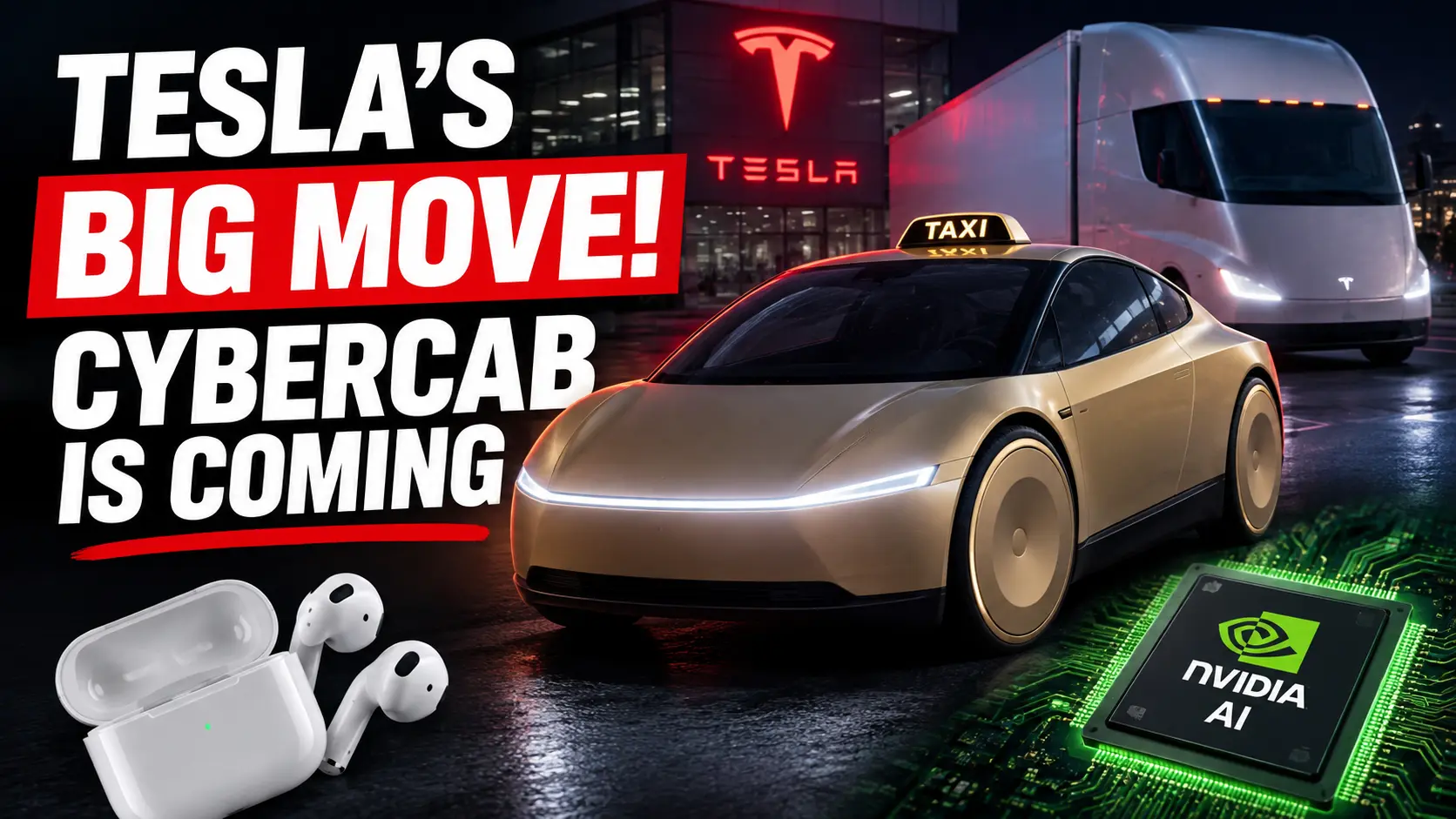
Tesla CyberCab Launch, Tesla Semi & Apple AI AirPods: Latest Tech News 2026
Alright, so there is a lot happening in tech right now, and honestly, some of these stories are pretty wild.
We’ve got Tesla making a huge move with the Semi, the CyberCab launch getting closer, Apple accidentally revealing unreleased products in its own software, Nvidia putting an insane amount of money behind OpenAI infrastructure, and even Google making Android sideloading more difficult.
So let’s just get into it.
Tesla Just Got a Massive Semi Order
First up, Tesla just landed an order for 500 Tesla Semis from Einride, a Swedish freight company.
And this isn’t some tiny test order either. Einride says this is the largest Tesla Semi deployment in the world.
They’re planning to roll these trucks out over the next two years, with the first phase starting in September 2026.
The trucks are going to operate in places like California, Texas, New Jersey, Illinois, and Georgia, and one of the companies they’ll be hauling freight for is Amazon.
What’s interesting here is that these are still normal, driver-operated trucks. So we’re not talking about 500 autonomous Tesla Semis driving around by themselves.
Einride will use its own software, called Saga AI, to figure out things like routes, charging, and which truck should take which load.
And honestly, this is a pretty big deal for Tesla because the Semi has been around forever at this point.
Tesla showed it back in 2017, and PepsiCo started getting the trucks in late 2022.
But we’re finally starting to see some bigger commercial deployments.
And if Tesla can prove that these trucks really are cheaper to operate than diesel trucks over the long term, that’s where the Semi could become a much bigger business.
The CyberCab Launch Is Getting Very Close
Now let’s talk about the CyberCab, because this one is getting really interesting.
Tesla has officially announced a launch event for the CyberCab in Austin.
And the way they’re inviting people is actually kind of funny.
If you take a Tesla robotaxi ride between August 17th and August 23rd, you’re automatically entered into a drawing.
Take another ride? You get another entry.
Tesla is picking just five winners, and they’ll be notified on August 25th.
So, yeah, the chances probably aren’t amazing if you’re only taking one or two rides.
But there is also a mail-in option, meaning you don’t actually have to buy anything or even live in a city where Tesla’s robotaxi service operates.
And that makes sense because legally, sweepstakes like this generally need a free way to enter.
The really interesting part, though, is that Tesla still hasn’t told us exactly when the actual event is happening.
But since the winners are announced on August 25th, I’d expect the event to happen pretty soon after that.
Probably late August or early September.
And this is a big moment for Tesla.
The CyberCab isn’t just another Tesla model.
It’s designed specifically around the idea of autonomous ride-hailing.
There’s no steering wheel, no brake pedal, and no traditional driver controls.
The whole idea is basically:
You get in.
You tell it where you’re going.
And the car handles the rest.
Of course, the entire business depends on Tesla actually getting the self-driving technology good enough to make that work safely.
That’s the part everyone is going to be watching.
Tesla Is Also Building a CyberCab Charging Hub
And Tesla isn’t just building the cars.
They’re also building the infrastructure around them.
There’s a new permit in Austin for a future robotaxi charging location that could have 48 Supercharger stalls, along with infrastructure for up to 80 wireless chargers.
And wireless charging makes a ton of sense for a vehicle like the CyberCab.
Think about it.
If there’s nobody inside the car, who is going to plug it in?
The whole point of the robotaxi is that it should be able to operate by itself.
So eventually, the CyberCab could simply park over a charging pad, recharge, and then go back out and pick up passengers.
That’s the kind of thing that starts making the whole robotaxi system feel much more realistic.
And Then There’s the Roadster
At the complete opposite end of Tesla’s lineup, we have the new Roadster.
This thing has been talked about for nine years now.
Nine years.
And somehow we’re still waiting for it.
But now we’re hearing more about Tesla potentially demonstrating SpaceX-related thruster technology with the car.
And I honestly don’t know what we’re going to see.
Maybe it doesn’t actually fly.
Maybe it just hovers.
Maybe it’s simply there to make the car accelerate ridiculously fast.
But whatever happens, Tesla clearly wants this thing to create some excitement.
And I actually think that’s important.
Tesla hasn’t launched many truly new vehicles recently.
The CyberCab would be one completely new direction, while the Roadster is basically the crazy, expensive technology showcase at the other end.
So you’ve got this tiny autonomous robotaxi on one side and a ridiculous high-performance sports car on the other.
It’s a pretty interesting combination.
Apple Just Leaked Its Own Products
Now let’s switch over to Apple.
This one is honestly hilarious.
Apple apparently put references to a bunch of unreleased products inside its own software.
And one of the most interesting ones is AirPods with cameras.
We’ve been hearing rumors about camera-equipped AirPods for a while now, but this is different because there’s apparently actual demonstration footage inside Apple’s software.
The video reportedly shows someone holding up a book, and the AirPods are able to recognize what’s in front of them.
The idea is that the cameras feed information into Apple’s Visual Intelligence system, and then Siri can answer questions about what you’re looking at.
So imagine you’re walking around and you see something you don’t recognize.
Instead of pulling out your phone, you could potentially just ask Siri about it through your AirPods.
That’s pretty wild.
And apparently Apple may actually call these AirPods Pro, rather than AirPods Ultra like some earlier reports suggested.
There’s also a second version apparently being developed for later.
So it looks like Apple may be getting pretty serious about putting cameras into things we already wear every day.
Of course, there’s a huge privacy question here.
Because unlike a phone camera, these cameras would literally be sitting on someone’s ears while they’re walking around other people.
Apple is going to have to explain that part very carefully.
Apple Apparently Has a Lot More Coming
And the AirPods aren’t the only thing that showed up.
Apple’s software also reportedly references things like a new HomePod mini, a Home Hub, a tabletop robot, a new MacBook Pro with an M6 chip, future iPhones, a foldable iPhone, and an updated Apple TV.
So Apple clearly has a lot of stuff in development.
And honestly, the funniest part is that Apple itself may have given us one of the best looks at these products.
Not a supplier.
Not a leaker.
Apple’s own software.
Somebody probably wasn’t very happy about that.
The Model Y L Is Doing Better Than Expected
Back over at Tesla, the new Model Y L is also turning out to be pretty interesting.
This is the bigger Model Y with three rows and six seats.
Tesla rates it at about 325 miles of range.
But Edmunds reportedly got around 358 miles in real-world testing.
That’s actually pretty impressive.
Especially because this isn’t a lightweight car.
It’s bigger, heavier, and has three rows.
And yet it managed to go farther than the official estimate.
The biggest problem is probably the price.
The launch version costs around $61,990.
That’s a lot of money for a Model Y.
If you regularly carry five or six people, though, I can definitely see the appeal.
But if you only need the third row once in a while, I’d probably save the money and get one of the cheaper versions.
Tesla Finally Got Its Cybertruck Tooling Back
There was also that weird situation with the Cybertruck supplier Angstrom.
Tesla had tooling and parts sitting inside the supplier’s facility, and when the company was shutting down, Tesla couldn’t simply walk in and take its property back.
So Tesla went to court.
The court basically allowed Tesla to recover the equipment.
And this wasn’t something Tesla could easily replace.
The company said some of the tooling could take five or six months to rebuild.
So I can understand why Tesla treated this as an emergency.
The good news is that Tesla got the equipment back, so this particular problem appears to have been resolved for now.
Nvidia Is Going Absolutely Crazy With AI Infrastructure
Now let’s talk about Nvidia.
Because this is where the numbers start getting ridiculous.
Nvidia is reportedly backing a massive OpenAI data-center project in Ohio, potentially involving 8 gigawatts of capacity.
That’s an enormous amount of computing power.
And what’s really interesting is that Nvidia is helping guarantee the financing.
Basically, Nvidia is helping make sure the project can get the money needed to build the infrastructure that will eventually buy Nvidia’s own chips.
It’s a pretty fascinating relationship.
OpenAI needs computing.
Nvidia sells the computing hardware.
Someone has to finance the data centers.
And now Nvidia is becoming part of that financing story too.
If AI demand continues growing at this pace, we’re probably going to see more deals like this.
Stripe Could Be Buying OpenRouter
There’s also a pretty interesting rumor that Stripe could be buying OpenRouter for more than $7 billion.
If you don’t know what OpenRouter does, the basic idea is pretty simple.
Instead of a developer connecting separately to OpenAI, Google, Anthropic, and dozens of other AI companies, they can connect through OpenRouter.
It basically sits in the middle and gives developers access to a huge number of models.
And that makes the rumored Stripe deal pretty interesting.
Stripe sits between businesses and payments.
OpenRouter sits between businesses and AI models.
So strategically, I can actually see why Stripe would be interested.
But again, neither company has confirmed the deal, so I’d definitely treat that one as a rumor for now.
Google Is Making Android Sideloading More Difficult
And finally, let’s talk about Google.
One of the biggest differences between Android and iPhone has always been the ability to install apps from outside the official app store.
That’s called sideloading.
Well, Google is now making that process significantly more annoying.
In some countries, users will eventually have to enable a special setting, go through warnings, and then wait 24 hours before they can finish installing an app from an unverified developer.
Google says it’s doing this because of malware and fraud.
And I completely understand the security argument.
But at the same time, Android is becoming less open.
For the average person, this probably won’t change anything.
Most people never sideload apps anyway.
But for developers and power users, this is a pretty significant change.
And it’s interesting because at basically the same time, Apple is being pushed in the opposite direction in Europe, where regulators are forcing Apple to make alternative app distribution easier.
So you’ve got Google making Android more controlled while Apple is being forced to make iOS more open.
That’s a pretty interesting reversal.
And There’s Even More Happening
There are a bunch of smaller stories too.
Tesla has now built its six-millionth battery pack at Giga Shanghai.
Google is targeting roughly 13 million Pixel phones for 2026.
Apple patched a macOS security flaw that was reportedly being actively exploited, so if you’re running an older version of macOS, definitely update.
Fairphone has also started selling its repairable Android phone in the United States, with replaceable components and software support going years into the future.
And Apple’s next Apple TV is expected to get a newer Siri Remote and a faster chip.
So yeah, there’s a lot going on.
The Bigger Story
But when you step back and look at all of this together, I think there’s a pretty obvious trend.
AI is becoming part of everything.
It’s going into cars.
It’s going into earbuds.
It’s going into phones.
It’s going into robots.
It’s powering massive data centers.
And companies are now spending billions and billions of dollars trying to build the infrastructure needed to support it.
Tesla is betting that AI can turn a car into a robotaxi.
Apple is looking at putting cameras into something you wear on your ears.
Nvidia is helping finance the infrastructure needed for AI computing.
Google is trying to make Android safer by controlling where apps come from.
And companies like Unitree are trying to turn humanoid robots from cool demonstrations into actual products.
Honestly, I think we’re still very early in this whole transition.
A lot of these technologies are going to take years to mature.
But we’re starting to see the pieces come together.
FAQ Schema Questions
These are good questions to include near the bottom of the article:
What is the Tesla CyberCab?
The Tesla CyberCab is an autonomous electric vehicle designed specifically for Tesla’s robotaxi service. It is designed without traditional driver controls such as a steering wheel and brake pedal.
When will the Tesla CyberCab launch?
Tesla has announced a CyberCab launch event in Austin, although the exact public event date has not yet been announced.
Who ordered 500 Tesla Semis?
Swedish freight company Einride ordered 500 Tesla Semis for deployment across several U.S. freight corridors.
Are Apple AirPods getting cameras?
Apple appears to be developing camera-equipped AirPods, based on references and demonstration material reportedly discovered in Apple’s software.
What is Nvidia doing with OpenAI?
Nvidia is reportedly providing significant financial backing connected to new AI data-center infrastructure being developed for OpenAI.
What is happening with Android sideloading?
Google is introducing additional verification and waiting requirements for installing apps from unverified developers outside the Google Play Store.